
HIV Knowledge
Sexually Transmitted Infections (STI)
Understand common STIs, symptoms, testing, treatment, prevention, links to HIV, and how often to screen — clear information for sexual health decisions.
Introduction
Sexually transmitted infections (STIs) — sometimes called STDs — spread mainly through vaginal, anal, or oral sex, and in some cases through contact with genital fluids. STIs affect people of all genders and ages. Many infections cause no obvious symptoms but can still spread to partners and lead to complications such as fertility problems, unintended pregnancy, or higher HIV risk if left untreated.
Learning about STIs is responsible self-care, not something to be ashamed of. Whether you have one partner or several, always use condoms or not, or take PrEP for HIV prevention, regular STI screening still matters — because PrEP and U=U protect against HIV but not against every STI. For HIV basics, see HIV and AIDS and HIV testing.
This article covers common STIs, symptoms, testing, treatment, prevention, how STIs interact with HIV, and how often to test. If you are living with HIV, STI care is part of long-term treatment — see HIV treatment and prevention. For personal questions, visit our FAQ or articles.
STIs can affect anyone who has sex. Regular screening is modern self-care, not shameful. Good clinics offer neutral, non-judgmental information.
Prevent STIs alongside HIV — condoms help both; PrEP and U=U focus mainly on HIV. See prevention. On HIV treatment, STI care is part of long-term care.
Many STIs are curable when found early. Delay can affect fertility and raise HIV risk. See our FAQ or articles for personal questions.
What are STIs?
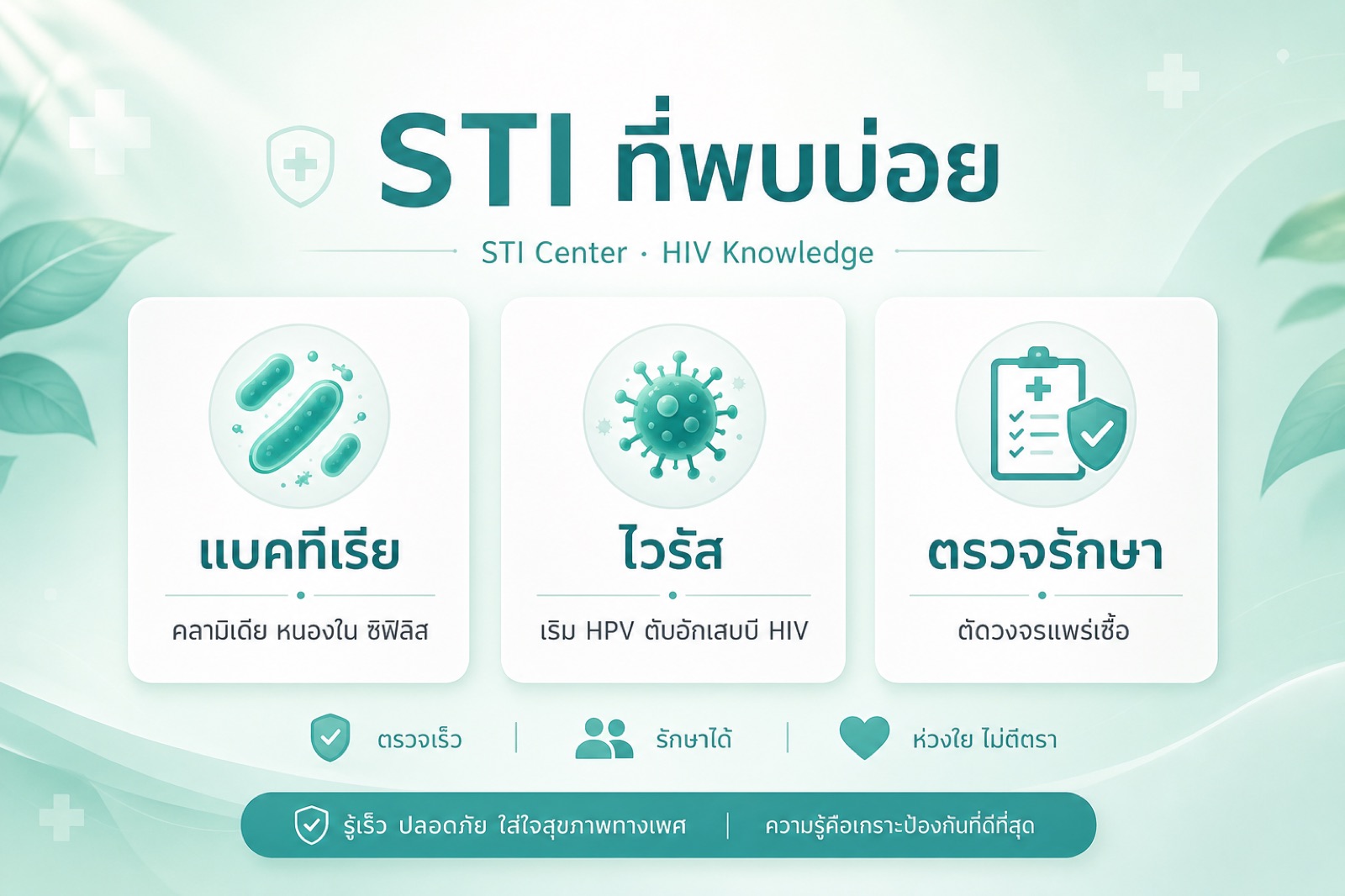
STIs are infections spread through sex or close sexual contact. Causes include bacteria (such as chlamydia, gonorrhea, syphilis), viruses (such as herpes, HPV, hepatitis B, HIV), and parasites (such as pubic lice). Some are curable with medicine; others can be managed but not fully cleared from the body. The term STI emphasizes infection that may exist before obvious disease appears.
STIs are not only for "high-risk" people — one sexual contact with an infected person can be enough. Likewise, no symptoms does not mean no infection. Honest talks with a clinician and testing based on risk are essential. STI services are confidential; fear or shame should not delay care.
STIs may have no symptoms but still spread. The STI term emphasizes infection before obvious disease.
Common STIs
Frequently seen STIs include chlamydia and gonorrhea — often in the throat, rectum, or genitals with few or no symptoms. Syphilis has stages from painless sores to rash and internal organ damage. Herpes causes blisters or sores; many people have mild or no outbreaks. HPV is linked to genital warts and some cancers. Hepatitis B spreads through blood and sex. HIV attacks the immune system.
| Condition | Cause | Typical symptoms | Usual treatment |
|---|---|---|---|
| Chlamydia | Bacteria | Often none; burning urine | Antibiotics |
| Gonorrhea | Bacteria | Discharge; burning urine | Antibiotics (may need resistance follow-up) |
| Syphilis | Bacteria | Painless sore; rash; swollen nodes | Antibiotics (penicillin) |
| Herpes | HSV virus | Blisters; sores; tingling | Symptom relief / antivirals (not curable) |
| HPV | Virus | Warts or no symptoms | Treat visible lesions; vaccinate |
| HIV | Virus | May be silent early on | Antiretroviral therapy (ART) |
Common STIs include bacteria, viruses, and parasites — treatment differs. Tables here are general; clinicians diagnose.
Typical symptoms
STI symptoms vary by germ and site (throat, rectum, vagina, penis). See a clinician for painful urination, unusual discharge, open sores, blisters, warts on genitals or mouth, swollen lymph nodes, body rash on palms or soles (possible syphilis), pelvic pain, or flu-like illness in early HIV.
No symptoms — why test anyway
- Chlamydia and gonorrhea are often silent but can harm fertility if untreated.
- Early syphilis sores may heal alone — the infection remains.
- Herpes can spread without obvious blisters (asymptomatic shedding).
- HPV and HIV may show no signs until complications appear.
Do not wait for symptoms if you have risk — new partners, condomless sex, or a partner with an STI. Testing enables early treatment and stops onward spread. See testing for test types and timing.
Many infections are silent, especially chlamydia and gonorrhea — test by risk, not by how you feel.
STI testing
There is no single test for every STI. Clinicians recommend panels based on your risk: urine tests, throat/rectal/genital swabs, and blood tests for HIV, syphilis, and hepatitis B/C — sometimes HPV or herpes testing when indicated. Honest answers about partners, condom use, and sexual practices lead to the right tests.
Before and after testing
- Ask which infections are included and turnaround time.
- Some exposures need a window period — follow clinical advice.
- A positive result is not the end — treatment and support exist.
- Encourage partners to test when appropriate to break transmission chains.
Testing is confidential; good clinics inform without judging. Book screening through our site when ready. On PrEP, regular STI checks are part of standard follow-up — see HIV prevention.
STI panels follow behavior — report sites of contact and condom use. Include HIV testing when appropriate.
Treating STIs
Bacterial STIs such as chlamydia, gonorrhea, and syphilis are usually cured with antibiotics when you finish the full course — do not stop early when symptoms fade. Gonorrhea resistance exists in some regions; follow-up testing may be needed. Viral STIs such as herpes are managed with medicines that ease outbreaks and reduce transmission. HPV focuses on monitoring and vaccination. HIV requires ART per HIV treatment guidance.
After diagnosis — what to do
- Complete all prescribed medicine and attend follow-up visits.
- Avoid sex or use condoms until your clinician says it is safe (varies by infection).
- Tell partners who may have been exposed to get tested and treated.
- Discuss pregnancy or family plans if relevant.
Finish prescribed treatment, especially antibiotics. Do not stop when symptoms fade; notify partners when advised.
Preventing STIs
No single method prevents every STI in every situation, but layered strategies help a lot. External and internal condoms used correctly from start to finish reduce many STIs. Fewer partners or agreements about testing and honesty also lower risk. HPV and hepatitis B vaccines are highly effective when completed as recommended.
PrEP strongly prevents HIV but not chlamydia, gonorrhea, syphilis, herpes, or HPV. U=U prevents sexual HIV transmission but not other STIs. People on PrEP or partnered with someone with U=U should still use condoms and screen for STIs as needed. Read more on prevention.
Condoms, HPV/hepatitis B vaccines, and fewer partners of unknown status help. PrEP does not replace condoms for STIs.
How STIs and HIV interact
STIs and HIV interact both ways. STIs — especially those causing sores or inflammation (syphilis, herpes, gonorrhea) — raise HIV acquisition risk because damaged mucosa and immune cells gather at inflamed sites, giving HIV easier entry. Conversely, people with untreated HIV and another STI may shed more virus, increasing transmission unless HIV is suppressed to undetectable.
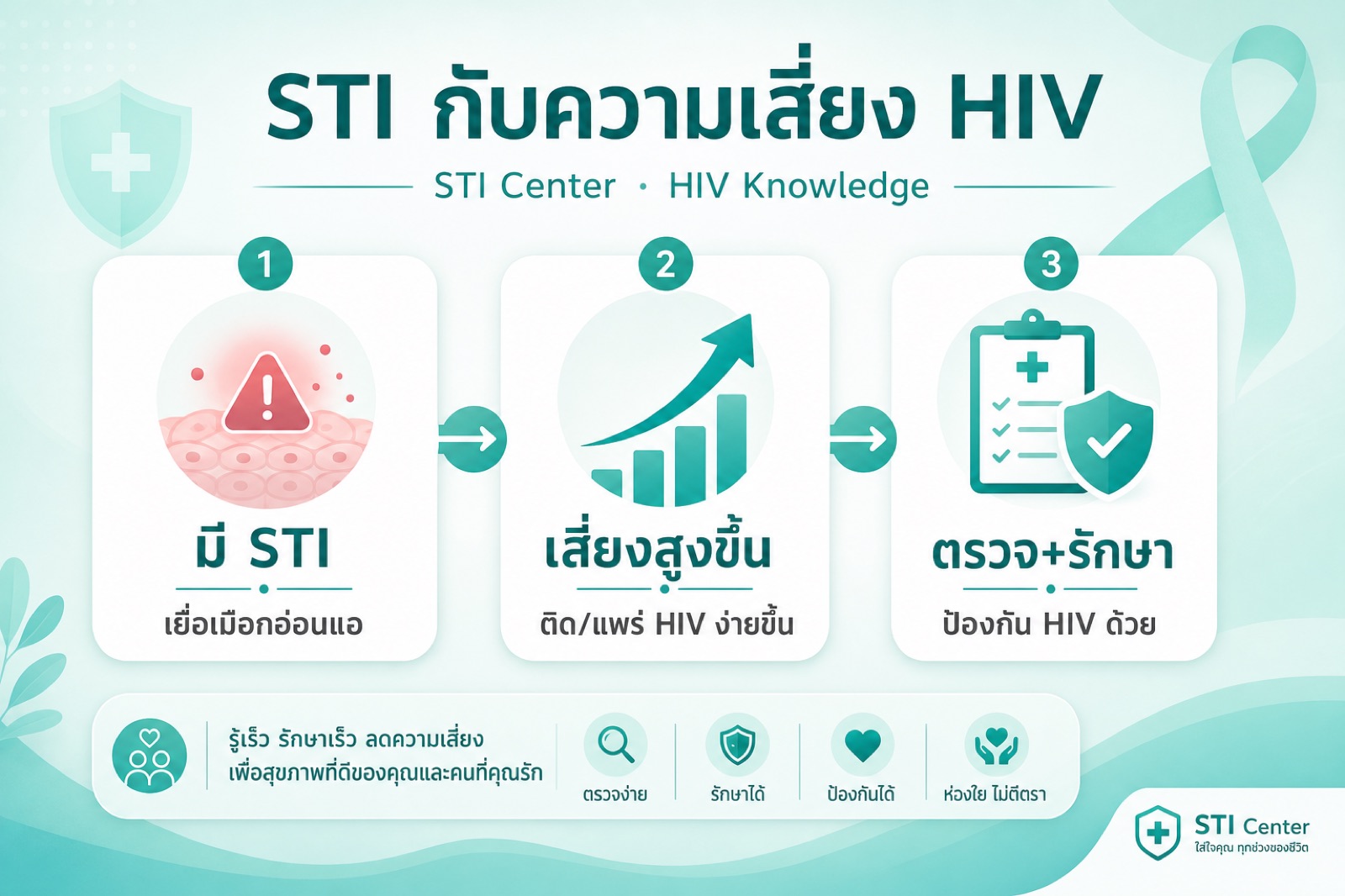
People with HIV on ART who are undetectable have very low sexual HIV transmission risk (U=U) but can still get other STIs — so screening remains important. If you are HIV positive, coordinate STI care with your HIV team. If HIV negative, condoms, PrEP, and treating existing STIs work together to lower acquisition risk. See HIV and treatment for the full picture.
Inflammatory STIs raise HIV risk — treating STIs is HIV prevention too.
How often to test for STIs
STI screening frequency depends on behavior and risk — there is no one-size-fits-all schedule. People with new or multiple partners often test at least once or twice a year. Those with frequent condomless sex, chemsex-related risk, or repeated STIs may need testing every three to six months. People on PrEP usually follow PrEP monitoring schedules, which may be more frequent.
When to test right away
- You notice possible STI symptoms (sores, discharge, burning, rash).
- A partner tells you they have an STI.
- Condomless sex with someone whose status you do not know.
- A condom breaks or slips during sex.
HIV testing should accompany STI screening when risk overlaps. If unsure which tests you need, ask a clinician. See our FAQ and articles. Calendar reminders twice a year help many people stay on track.
Screening frequency follows risk — often 1–2 times yearly to start; PrEP users may test more often. Test promptly with symptoms or partner notification.
Summary
STIs are a normal part of sexual health that can be prevented and treated. Know common infections, watch for symptoms, test for your risk level, finish treatment, and combine condoms with eligible vaccines to protect yourself and partners. Do not wait for symptoms if you know you were exposed — early testing is the best care.
STIs and HIV are linked: managing STIs lowers HIV risk, and HIV treatment with ART supports safer living. Read HIV and AIDS, testing, prevention, and HIV treatment for complete care.
STI care is normal — test, finish treatment, prevent with condoms and vaccines. Read HIV, testing, prevention, treatment.